Balance. Summary
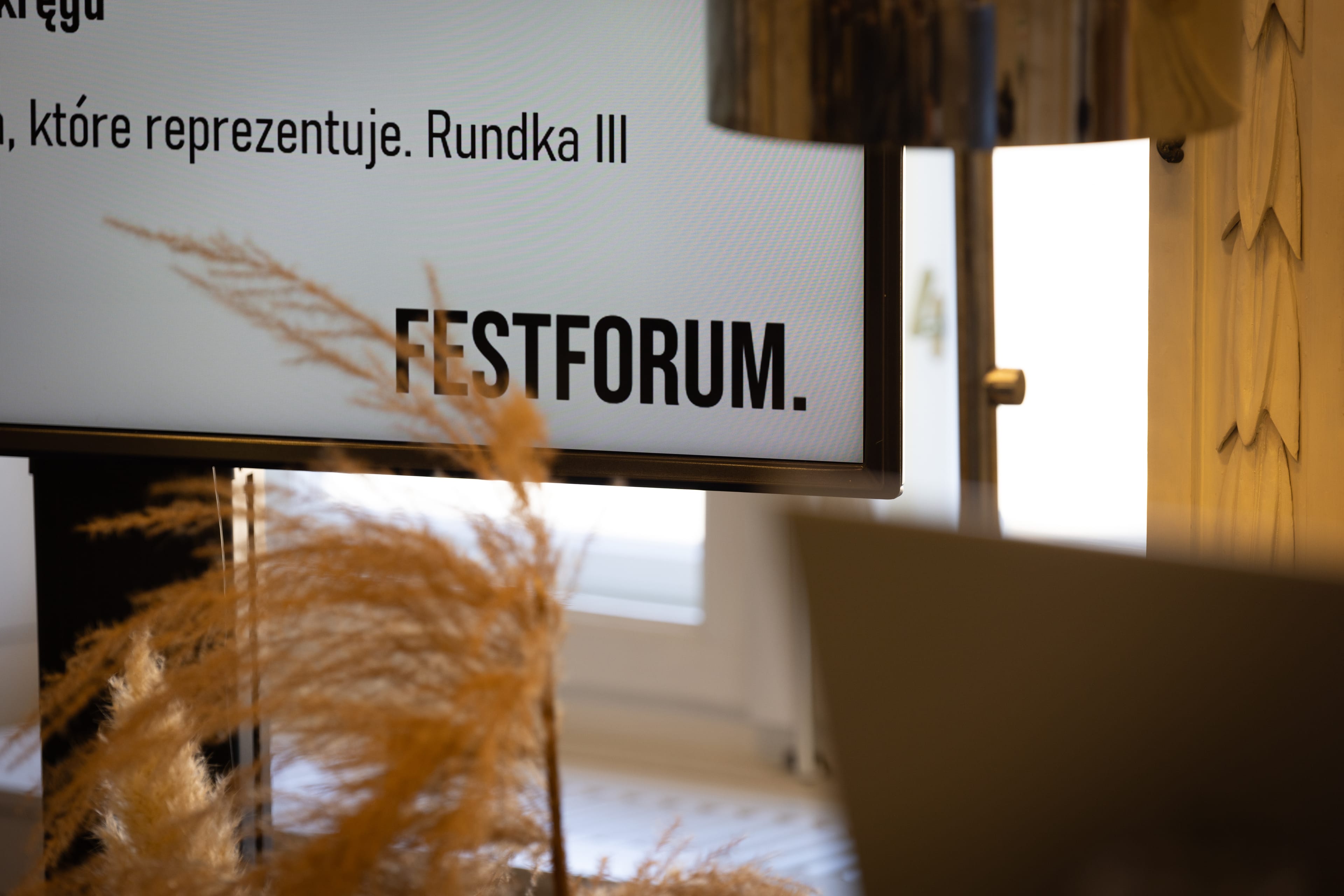
The November meeting was designed as a process: from inspiration, through relationship-building, to specialist workshop work and public debate. The conference opened with a lecture by Natália Oszkó-Jakab, Director of the Valley of Arts Festival and board member of the European Festivals Association, who presented the festival as a tool for long-term development within the logic of ESG (Environmental, Social, Governance). Her presentation introduced a practical perspective on managing a sustainable cultural project, based on revenue diversification, working with data, relationships with the local community, and environmental responsibility. It was a clear signal that the conversation about the future of festivals must move beyond crisis narratives and focus on models of sustainability.
The next stage consisted of relationship-building and networking workshops, aimed at strengthening one of the key assumptions of FEST FORUM — building a real industry community. Participants had the opportunity to get to know one another, name their needs and resources, and overcome barriers to establishing cooperation. This element of the program, deliberately placed at the beginning of the event, created a safe space for further, in-depth substantive work.
The first block of industry workshops focused on three areas defined by the Program Council as key to the balance and future of the sector: PEOPLE, ENVIRONMENT, and ACCESSIBILITY. Discussions and project work addressed the work culture and well-being of festival teams, relationships with local communities, and designing events inclusively from the very beginning. Models of co-creating festivals with residents were analyzed, using the example of 9 Hills Festival, as well as practices for including people with diverse needs and a systemic approach to accessibility as an element of strategy rather than an addition to the program.
The second thematic block, held the following day, was devoted to law and financing. The workshops provided practical support in the areas of relations with collective management organizations, drafting co-organization agreements, implementing the Act on the Protection of Minors, and building financial resilience through the diversification of revenue sources, crowdfunding, and the use of less obvious grant programs. Particular emphasis was placed on strategic thinking, multi-year planning, and treating legal and financial security as a condition for the sustainability of festival projects.
An important element of the second edition was bringing reflection on festivals into public discourse. Two debates open to the public and streamed online were organized: the discussion “Festivals: Rescue or Threat?” and the debate “Why FEST FORUM?”, summarizing the origins and purpose of the initiative. In this way, the festival sector did not confine itself to an industry conversation, but invited a wider audience to take part, recognizing that festivals are a social phenomenon and require transparent, multifaceted reflection.
Of particular significance was the industry debate “Why Do We Need Associations?”, whose continuation in January 2026 — this time in an online format — led to a clear conclusion regarding the need to establish an association within the FEST FORUM community. Participants supported the model of an inclusive association of individuals, with institutions participating as supporting members, as well as a rotating formula for organizing future editions — hosted in different Polish cities by different entities and institutions. This marked a transition from diagnosis to designing a lasting structure of cooperation.
Funding from the National Recovery Plan also enabled a significant step toward the digitalization of activities. In January 2026, four workshops from the November edition were repeated online, and two industry meetings were organized, devoted to associations and the model of a traveling FEST FORUM. At the end of February 2026, the FEST FORUM online platform was launched — a space collecting materials, reports, and good practices, as well as developing the online FEST COMMUNITY, where users will be able to co-create knowledge resources, share articles and research, comment on materials, ask questions, and establish professional contacts.